Shirudo
eBPF Runtime Security Protection Platform
Introduction
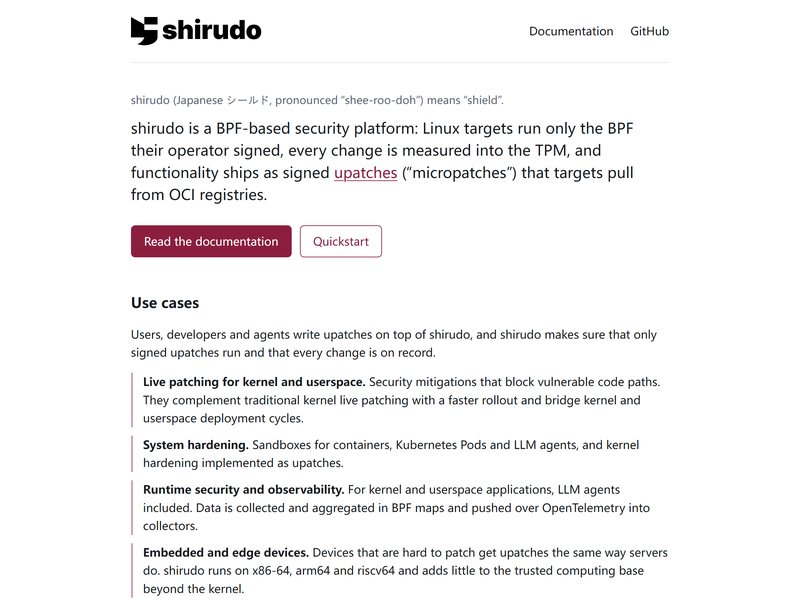
“Shirudo” is the transliteration of the Japanese word “shield”; it refers to an open-source security platform based on BPF technology, which was jointly launched by OpenAI and Cisco in November 2026.
Its rule is as follows: Only BPF programs that have been signed by the operations team are allowed to run on Linux systems, and every change made to these programs is recorded in the TPM. New functionality is distributed in the form of signed “micro-updates,” and target machines retrieve these updates from the OCI repository.
There are four main applications: providing temporary fixes for both kernel and user-space programs, thereby blocking vulnerable code paths before official patches are released; enhancing system security by creating sandboxes for containers, Kubernetes Pods, and LLM entities; ensuring runtime safety and enabling monitoring through OpenTelemetry; and addressing the needs of embedded and edge devices for which updates may be difficult to apply. The solution is compatible with x86-64, arm64, and riscv64 architectures.
Minor patches can be written either by humans or by intelligent systems. The license used is BSD-2-Clause. This tool is designed for operations and security engineers; it does not have a graphical interface, and the learning curve is relatively steep for those who are unfamiliar with eBPF.